
After many hours of research and time spent exploring, I discovered a promising selection of pottery, stoneware and glass fragments nearby the river. I was so excited to find these things as it was quite an adventure to track them down. They’ve come up really nicely from cleaning and I’ve been able to identify some bottles from the lettering.

J.H Bailey Plymouth pharmacy bottle
Fragment showing “J.H.B Plym” lettering identifies it as a chemist bottle, circa 1920.

Large stoneware bottle
I found this lovely bottle on the surface of a river bank, half buried and it came up really nicely after cleaning. It has a nice iridescent shimmer in the light. There are no makers marks or lettering of any kind on it so I might struggle to find out what it is. It could quite possibly be an old ginger beer bottle or something like that. Judging by the neck hole, it probably had quite a long tapering neck.
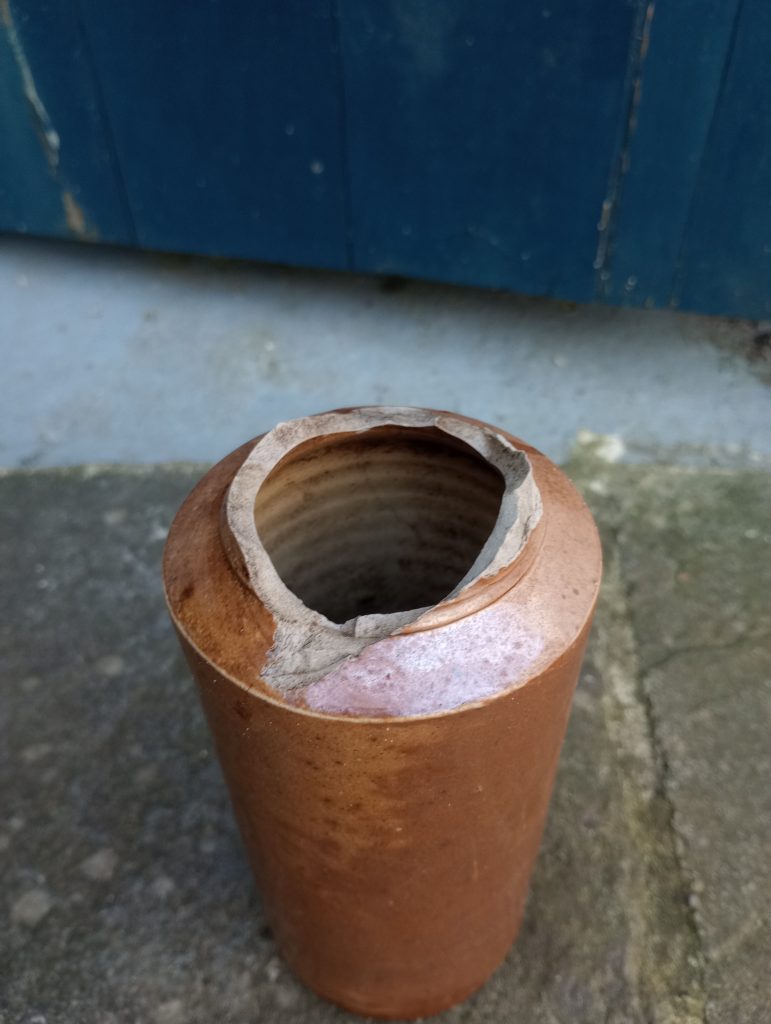

Small stoneware bottle
This was found on a river bank in a completely different area. It’s a solid little item and revealed a paler surface after giving it a good scrub. It makes a satisfying bubble sound filling it up underwater – just like a Gluggle jug.


Miscellaneous bits


Turn to break seal
The dotted glass from this bottle reminds me of the Lucozade one I found last year. I particularly like the vintage, decorative arrow on the cap. Like something you’d see on railway signage.


Foster Clarke, Maidstone, c1908-1910

A little research has found this to be either a fruit juice bottle or for lemonade! The website whatthevictoriansthrewaway.com says:
Bottles embossed with the name of ‘Foster Clark & Co, Maidstone’, for ‘Eiffel Tower Fruit Juices’. In 1910, Foster Clark’s became a limited company. Bottles made after this date have ‘Foster Clark Ltd’ rather than ‘Foster Clark & Co’. The firm also made lemonade.
https://www.whatthevictoriansthrewaway.com/project/foster-clarks-bottles/
Impossible to know if this is the former or the latter.

You can see an M shape inside a box- it looks more naturally like an “M” than a “W”. I’ve only just found out these are called makers marks….
Update: A bit of research on great-glass website shows it might be a Wood Brothers, England makers mark (1854-1981) but I’m not convinced.

In fact, it looks a lot closer to the bottle here on ebay: https://www.ebay.co.uk/itm/256443753637. That’s an antique Aqua Glass Eno’s Fruit Salt Derivative Compound Bottle.
This could make it a c1900-1912 pharmacy bottle from James Crossley Eno – a producer of antacids/pharmacy products: https://en.wikipedia.org/wiki/Fruit_salt
Here’s a definitive fact sheet about the Eno’s fruit salts bottle: https://victoriancollections.net.au/items/5ab8539321ea7413c80a48a4
That would mean if it’s an M, its the production location of Melbourne, Victoria, Australia

I thought these two parts went together as it’s the same glass colour but the larger bottle with the “M” mark, doesn’t match the shape found on the Foster Clarke bottles.

I love the octagonal shape of these bottles.
Snail(?) shell
I saw this at the bottom of the river – not sure what kind of shell it is but looks more like a sea creature shell than a snail.
Edit: found out it’s most likely a White-lipped Banded Snail, found throughout the UK: https://www.uksafari.com/bandedsnails.htm

